
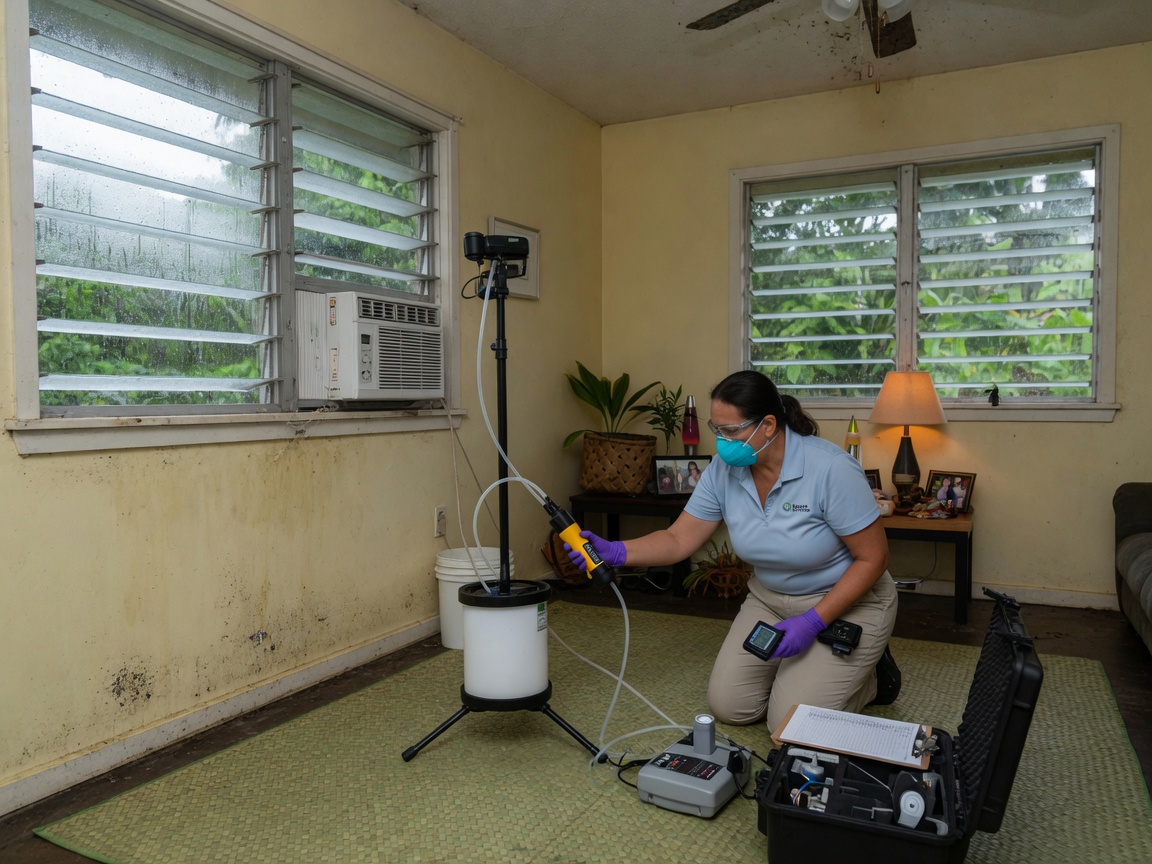
Hilo's tropical rainforest climate keeps relative humidity high year-round, so moisture infiltrates older single-wall wooden homes in Puueo and Waiakea even when windows stay closed during heavy rain. This constant dampness allows mold colonies to grow inside wall cavities and under floorboards where standard visual checks miss them. Testing must include air and surface samples from multiple rooms plus attic and crawl-space access points because the mild temperatures never fully dry out building materials the way drier climates do.
Many homes built before the 1980s in Downtown Hilo and along the Hilo Bay shoreline lack modern vapor barriers, so radon and volatile organic compounds from soil and older finishes accumulate faster than in newer subdivisions near Keaau. Technicians pull samples at breathing height and near HVAC returns while noting how trade winds push air through louvered windows, creating uneven pollutant distribution that a single-point test cannot capture. Results guide whether source removal or improved mechanical ventilation will actually solve the problem rather than mask it.
Laboratory analysis of spore counts, moisture readings, and carbon dioxide levels is compared against Hawaii County building practices rather than mainland baselines because the frequent afternoon showers here drive different seasonal patterns. Homeowners in Pahoa often see spikes after heavy rain events that push groundwater toward foundations, so testing includes exterior soil moisture checks around the slab to catch hidden intrusion paths before they affect indoor readings.
Technician insight
In Hilo the thing that catches most people out with Indoor Air Quality Testing is how the constant afternoon showers keep soil and crawl-space framing damp for weeks, so mold readings spike in Waiakea homes even when the living areas feel dry. Homeowners often skip checking under the floor because the mild temperatures never trigger the usual warning signs.
Persistent Musty Odor After Heavy Rain
A Waiakea homeowner noticed a musty smell only after several days of rain. Testing revealed elevated mold spores in the crawl space where water had wicked up through the soil against the older pier-and-beam foundation. We collected air and surface samples, confirmed the species matched the damp framing, and recommended targeted drying plus improved ventilation rather than whole-house remediation.
Indoor Air Quality Testing Services We Offer
✓Mold Spore Testing
Air and surface sampling for mold types common in Hilo's wet climate, with lab results that flag species thriving in single-wall construction.
✓Humidity and Moisture Assessment
Room-by-room readings plus attic and crawl-space checks to locate hidden dampness caused by constant rain and poor cross-ventilation.
✓VOC and Chemical Screening
Detection of volatile organics from older building materials and finishes found in pre-1980 homes throughout Downtown Hilo and Puueo.
✓Carbon Monoxide Monitoring
Placement of detectors near gas appliances and in tightly sealed rooms where rain keeps windows closed for days at a time.
✓Ventilation System Evaluation
Inspection of existing ducts and fresh-air intakes to determine whether trade-wind airflow is sufficient for homes near Liliuokalani Gardens.
✓Allergen and Dust Mite Analysis
Targeted sampling for dust mites and pollen that concentrate in humid carpet and upholstery during Hilo's extended rainy periods.
Indoor Air Quality Testing Cost in Hilo, HI
| Service | Typical Range | What Affects It |
|---|---|---|
| Basic IAQ Test (3 samples) | $250–$400 | Single-story home in Waiakea or Puueo; additional samples raise cost |
| Comprehensive IAQ Test (6+ samples) | $450–$750 | Includes attic, crawl space, and exterior moisture checks |
| Mold Spore Add-On | $150–$250 | Per additional room or surface type |
| Follow-Up Testing | $200–$350 | After remediation or seasonal re-check |
Ranges are typical for Hilo, HI and confirmed with an exact written quote before any work starts.
How it works
- 1
Site Walk-Through
Technician inspects layout, notes window orientation to trade winds, and identifies moisture-prone zones in attics and under floors.
- 2
Sample Collection
Air, surface, and moisture readings are taken from multiple rooms plus exterior soil checks around the foundation.
- 3
Lab Analysis
Samples are sent for spore counts, VOC levels, and humidity data compared against Hilo-specific conditions.
- 4
Report And Recommendations
Written findings include room-by-room results and practical next steps such as targeted dehumidification or ventilation upgrades.
Pricing
Costs depend on number of samples and home size; most Hilo jobs fall in the ranges below.